|
Different uses for voting
need different types of voting. |

 | Primer on Voting Rules | |

| The best voting rules are inclusive, well centered and decisive. They can make a group more popular, stable and quick. |
| After this primer shows the need for better voting rules, the voting games will show the simple steps in each tally. The supporting references, statistics and glossary are online. All are in the pdf for mobiles or printing in English or español. |
Introduction |
|---|
Two of Many Tragedies

What can big swings in other policies do?
Jump to the next slide by clicking the gray link:
What's Wrong? ↓
The Northwestern U.S. tore itself apart by changing forestry laws again and again. In a year with weak forestry laws, hasty logging wastes resources. But sudden limits on logging bankrupt some workers and small businesses. If this policy pendulum swings far, it cuts down forests and species then families and towns, again and again.2
Businesses and agencies often lose money and power when a council changes hands and policies swerve. This is a major cause of war-like politics.
Can we reduce such raging or silent tragedies? Better tools give real hope; we can reduce the tragedies caused by the old voting tools.
What's Wrong
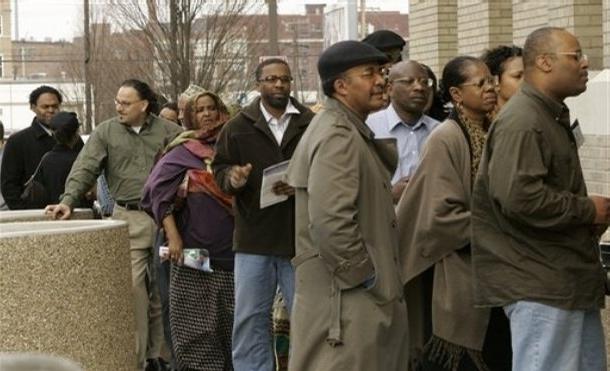
Will their votes have any effect?
Our defective voting rules come from the failure to realize this:
There are different uses for voting, and some require different types of voting.
But if a third option or candidate appears, the contest becomes more complicated. Then that old yea or nay type of voting is no longer suitable.
Sometimes what we want is not the election of a solitary official. We want to elect a whole council that represents all of the voters. Then we do not need to divide voters into winners and losers. Instead, we need a way of condensing them, in the right proportions, into their chosen leaders.3
Yes-or-no voting is even worse at giving fair shares of seats, or at one-time funding of projects, or at adjusting many ongoing budgets, or finding a balanced policy.
Eras in Democracy |
|---|
In the 19th Century: Winner-Take-All Districts lead to Off-Center ;Councils
A district with only one rep tends to develop only two big parties. Only their candidates have good chances. So the voters get only two real candidates; that is a very limited choice.4
If the voters in a few districts are given real choices, all power might flip from one faction of reps to another. Its majority (dark blue below) sets all policies and budgets. Hopes and fears of sudden policy flips polarize politics. Each battle is brutal because the winner takes all.
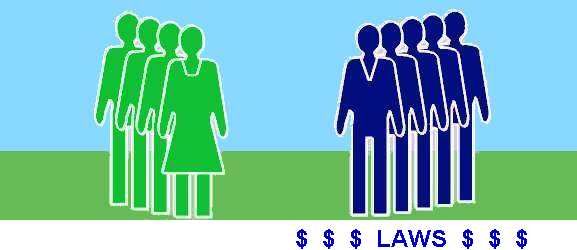

Typical Council Elected By Plurality Rule
In the 20th Century: Fair-Share Representation leads to Off-Center Majorities
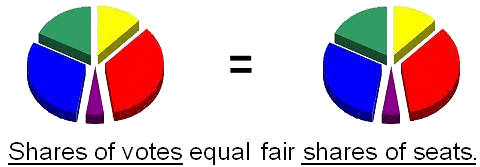
It elects several reps from each election district. It gives a group that earns, say 20% of the votes, 20% of the council seats. Thus PR delivers fair shares of representation.6 (In the USA, this is sometimes called “Fair Representation”.)
So the side with the most seats (blue and black) forms the ruling majority; then it enacts policies skewed toward its side.
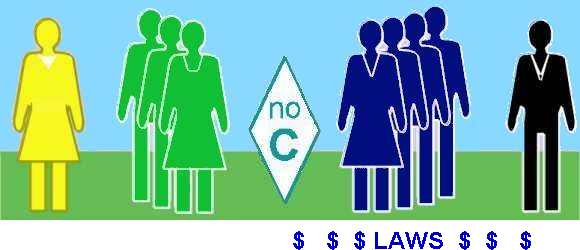
Typical Council Elected By Proportional Representation
In the 21st Century: Ensemble Councils lead to Broad, Centered Majorities
 That’s the target.
Many voters in the winners' wide base of support won't want narrow centrist policies. They‘ll likely want policies to combine the best suggestions from all groups.

$
$$LAWS$$$ Ensemble Elected By Central And Proportional Rules
 Progress of Democracy
A compromise policy tries to negotiate all ideas. But contrary ideas forced together often work poorly.
A balanced policy blends compatible ideas from all sides. This process needs advocates for diverse ideas. And more than that, it needs independent moderators, These swing-voting reps can please their wide base of support by building moderate majorities in the council.
Excellent policies are a goal of accurate democracy. Their success is measured by data on a typical voter's education and income, freedom and safety, health and leisure.7
Old tally rules often skew results and hurt a democracy.
An ensemble is inclusive; yet it is centered and decisive.
— to help make its actions popular, yet stable and quick.
The best tools to set budgets or pick a policy will also show these qualities in our stories, graphics and games.
|
|---|
Nine Voters
Throughout this primer, we're going to show political positions in this compelling graphical way.

High taxes, great gov. services Low taxes, poor gov. services
Plurality Election
Ms. K is the candidate nearest four voters.
L is nearest two and M is nearest three.
Candidates L and M split the voters on the right.
Who gets the plurality (the largest number), K, L, or M.
Who wins the second-largest share of votes, K, L, or M?
A mere plurality gives the winner a weak mandate.
This is the authority effective votes loan to a winner. Strong mandates –for the reps, budgets and policies– support and speed action to achieve popular goals.
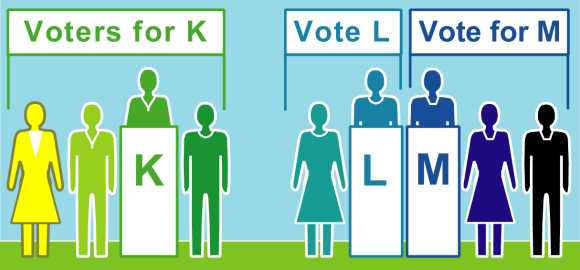
K is nearest four voters. L is nearest two. M is nearest three.
Runoff Election
The two (teal) who had voted L now vote for M.
Did teal voters get more power than others, Yes, or No?
Only four “wasted votes” fail to elect anyone.
More ballots became effective votes, a basic goal
Did the plurality election waste more votes, Yes, or No?
So did the runoff result in a stronger mandate? Yes, or No?
Later, these voters will use a rule that asks,
“Where is our center?”
And a bigger group will use a rule that asks,
“Which trio best represents all of the voters?”
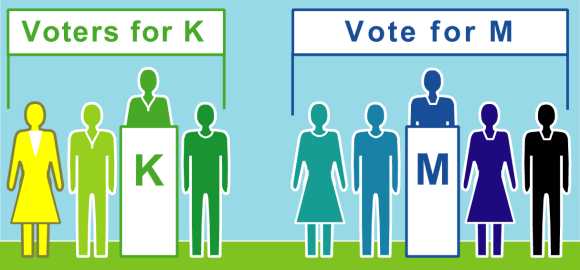
Candidate M wins the runoff.
Politics in Two Issue Dimensions
This photo shows voters choosing positions all across two issue dimensions: left to right plus up and down. A person's position on the first issue does not help us guess their position on an independent issue.
A voter may rank candidates on any issue(s). He prefers the candidate he feels is closest.
Please step down if you want fewer protections.
Take more steps for more change.”
The slides on simulation games and research will show more tallies with two and even three issue dimensions.
more or less regulation ↕ and taxes for services ↔

Kay wins a plurality. Em wins a runoff.
Chief Executive |
|---|
The Goal of Instant Runoff Voting is this:
A majority winner
from a single election.
| Voting is easy: You simply rank your favorite as your first choice, and backup choices: second choice, third and so on as you like. Your civic duty to vote is done.
Now your vote counts for your top-rank candidate. |
Instant Runoff Voting, a Tally Analogy
| Here is an analogy: Each candidate puts out a box. A voter puts his ballot in his favorite candidate's box. The ballots are counted. If the box gets a majority of the ballots, it wins. If not, the voter moves his ballot to another candidate's box. Or, he waits, hoping others will move their ballots to his favorite box. To break that deadlock, we have a rule: If a round of counting ballots finds no winner, the box with the fewest votes is eliminated. Its ballots go to each voter's next backup choice — probably a candidate with similar views and more popularity. These transfers make voters condense into large groups supporting strong candidates. Ballots are counted again to see if any candidate gets at least half of the current top ranks. In practice, each voter ranks the candidates as 1st choice, 2nd choice, 3rd etc. Then election officials move ballots between boxes or a computer tallies them. |
Why Support Instant Runoff Voting, IRV
|
Plurality Voting Patterns
| Running for president in South Korea, the former aide to a dictator faced two popular reformers. The two got a majority of the votes but split their supporters. So the aide won a plurality. (37%, 28%, 27%, 8%) The winner claimed a mandate to continue repressive policies. Years later he was convicted of treason in the tragic killing of pro-democracy demonstrators.5 A voter‘s backup is often like his favorite, but more popular. So by dropping one reformer, IRV might well have elected the stronger one with a majority. The U.S. also has seen major elections in which two candidates on the left split their voters or two on the right split theirs. Sometimes this increased our national tragedies. (Can you name such an election and its tragic results?) |
Instant Runoff Voting Patterns
From five factions to one majority.

3) Ms. Green loses.4) Ms. Carmine loses.This chief executive starts in a big band of voters on
the biggest side, then builds a majority. This helps her
work with reps on the biggest side of a typical council.
IRV may be helping women achieve parity in politics.6
IRV lets you vote for the candidate you really like.
And even if that option loses, your vote isn't wasted;
it goes to your next choice.
Council Elections |
|---|
Three Single-Winner Districts
A class of 27 wants to elect a planning committee. Someone says, “Elect a rep from each seminar group.”
In the first seminar group, 5 voters elect B to power, while 4 people waste their votes on a loser, J. In the last seminar, 8 voters elect M, but 3 of those votes are wasted in a surplus that has no effect. The total is 12 wasted votes.
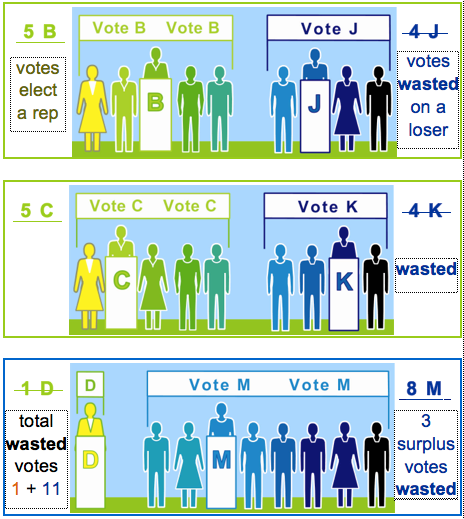
A minority with 11 voters gets majority power with 2 reps. But if it were spread out evenly, it would get none.
One Fair-Representation District
A better suggestion says, “Keep the class whole.
Change the definition of victory from half of a small
seminar to a 1/4 of the whole class, plus one vote.”
So 3 reps must get 3/4, not just a plurality.
Now there are just 6 wasted votes.
Wasting fewer votes gives the council a
stronger mandate.
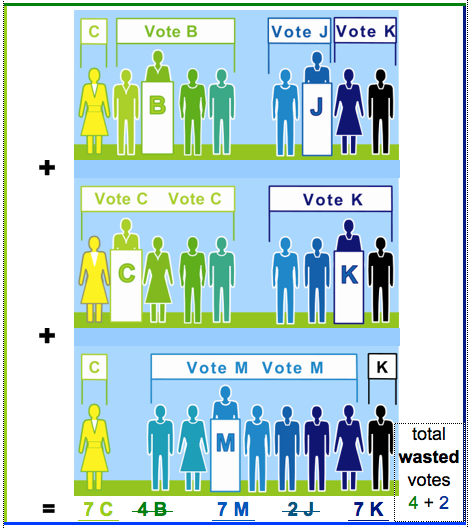
Now a majority gets two reps and a minority gets one.
Many wasted votes may expose a gerrymender.
The principle of Proportional Representation is this:
Majority rule, by representing the
groups in proportion to their votes.
That is, 60% of the vote gets you 60% of the seats, not all of them. And 20% of the vote gets you 20% of the seats, not none of them. These are fair shares.
|
Why Support Proportional Representation
|
Fair Shares and Moderates
Those Chicago Republicans were usually moderates. So were Democratic reps from Republican strongholds. Even the biggest party in a district tended to elect reps who were more independent. They could work together and make state policies more moderate.4
(The transferable-vote game shows one way to get PR — which is also called Fair Voting, Proportional Voting, Full Representation, or Fair Representation.)
The seats won by women rose from 21% to 29%. The native Maoris reps incerased from 7% to 16%, which is almost proportional to the Maori population.5 Voters also elected 3 Polynesian reps and 1 Asian rep.
(The print edition and an interactive web page compare national statistics to show the effects of PR on the election of women, on policies and on the quality of life.)
Why Elect Women
New Zealand and Germany elect half of their MPs in single-member districts and half from Fair Rep lists. Their Single-Member Districts elect few women; but in the same election, the PR lists elect three times more women.
In every one-seat district, a party's safest nominee is likely to be a member of the dominant sex, race, etc. That adds up to very poor representation of all others.
PR leads each party to nominate a balanced team of candidates to attract voters. This promotes women.6 A team may have class, ethnic and religious diversity. And that gives us diverse reps to approach for help.
This credible threat made some parties decide that job experience was not as important as gender balance. So they dropped some experienced men to make more room for women on the party's list. And they won.7 Now they are incumbents with experience, power and allies.
Voting Rules and Policy Results
SMDs elect reps with a wide range of vote totals. So a majority of reps might not represent most voters. But PR requires the same total for each rep. So each majority of reps really stands for most voters. It leads to policies matching public opinion better.3
If those urgent needs overwhelm us, we neglect the essential need to reform their structural source: We often get poor results from poor policies due to poor representation coming from a poor voting rule. We might agree, helping voters control government is now an urgent need.
The countries with the best voting rules get the best quality of life, as measured in their international scores. We would all like better quality-of-life results for our country, and for our towns, schools, clubs and co-ops. So help friends talk about and try these voting rules.
Allocating Budgets |
|---|
Fair Shares to Buy Public Goods
Proportional Representation distributes council seats fairly. In the same way, voting can distribute some spending power fairly.
 Voting by rich men, poor men, “colored” men, women.
  Proportional Representation of all big political groups.
  Fair Share Voting by big groups of voters or reps.
$$$$LAWS$$$$
Fair shares give minority voters some power.
Local Control of Central Funds
In 2010, a Chicago alderman gave $1,300,000 to PB. It was a popular success. But a plurality rule made the votes and voters unequal. For example, in 2011 each vote to help a park won $501. That was its cost divided by its voters. But if cast for bike racks, each vote won a mere $31. That's too unfair. Even worse, most of the votes were wasted on losers. We can do better. We can give every voter the power to guide a fair share of money, with Fair Share Voting.
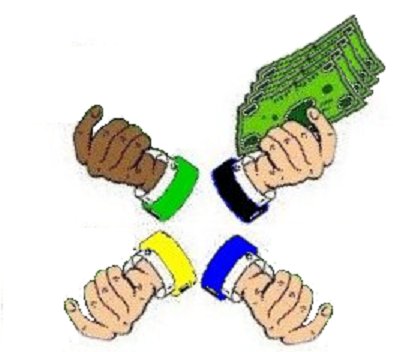
A costly winner makes many lose.
A bad election rule is even worse when it picks projects: It's not “cost aware,”; so it often funds a very costly item and cuts a bunch that get many more votes per dollar. To win this bad tally, load various items into one proposal. Keep raising its cost if that attracts more votes.
One year, a scholarship fund got many surplus votes. These were wasted votes because they had no effect. So the next year, many supporters chose not to waste a vote on this “sure winner.” It lost! They saw the need for a voting rule that would not waste surplus votes.
The principle of Fair Share Voting is:
Spending power for groups,
in proportion to their votes.
| That is, 60% of the voters can spend 60% of the fund, not all of it. Your ballot’s share of the fund lets you vote to pay your shares of the costs for your favorite items.
Voting is easy: simply rank your choices, like in IRV. Your ballot pays one share for each of its present top ranks—as many as it can afford. A tally of all ballots drops the item with the fewest shares. Those two steps repeat until each remaining item gets full funding.3 The voting games will make the details easy to grasp. Paying one share proves you feel the item is worth its cost and you can afford it in your high priorities. |
Merits of Fair Share Voting
- Each winner is a popular priority worth its cost: Each had to earn our “base number” of shares.
- FSV is fair to an item of any cost and to its voters: A ballot pays a costly share to vote for a costly item. cost / base = 1 share e.g. $100 / 20 ballots = $5 If more ballots divide a cost, each of them pays less.
- So, a ballot's money can help more low-cost items. This motivates a voter to give his top ranks to the projects he feels give the most joy per dollar.
- Votes can move from losers to backup choices so:
Voters split by similar proposals can unite on one
And the set of winners gets stronger support
because the ballots leave few wasted votes.
- After discussion, a quick poll can pick many items. It reduces agenda effects such as leaving no money for the last items or going into debt for them.
- It lets sub-groups pick projects, so it's like federalism, but without new layers of laws, taxes and bureaucracy. And it funds a big group even if they are scattered.
- Each big group controls only its share of the money. This reduces their means and motives for fighting.
- Fairness builds trust in spending by subgroups and raises support for more. This can reduce spending at the extremes of individual and central control.
- This does not give minorities too much power: A majority spends most of any fair-share fund. They set the policies that direct each department. They may end any program before the voting starts.
For Votes by Elected Councils
- FSV gives some power to reps in the opposition, so
Electing them is more effective, less of a wasted vote.
This may increase voter turnout. - They ease starvation budgets made to cause failures. This makes program management more efficient.
- A member can waste only her share of the fund. Voters can see a rep's grants to each project, tax cut or debt reduction and hold her accountable.
Fair Shares and Majorities
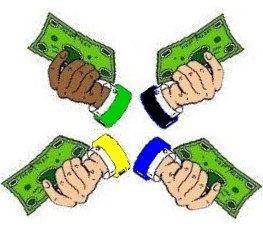
Fair shares
spread the joy and opportunities.
If a plurality or a majority spends all the money, the last thing they buy adds little to their happiness. It is a low priority. But that money could buy the high-priority favorite of another big interest group, adding more to their happiness.
In economic terms: The “social utility” of the money and goods tends to increase if we each allocate a share. Fair share, cost-aware voting gives more voters more of what they want for the same cost =more satisfied voters. Shares also spread good opportunities and incentives too.
In political terms: The total spending has a wider “base of support:” It appeals to more voters because more see their high priorities get funding. So our budget appeals to more people.
Each big group controls its share of the resources. This reduces their means and motives for fighting and dominating the other groups.
Plurality rules let surplus votes waste a big group’s power and let rival items split it, as seen on page 14. The biggest groups often have the biggest risks.
FSV protects a majority’s right to spend a majority of the fund. It does this by eliminating split votes, as did IRV, and surplus votes, as we’ll soon see.
Adjusting Budgets
Each budget level of an item is like a project: To win, it needs to get a base number of votes. It gets a vote when a ballot offers to share the cost up to that level or higher. cost / base = 1 offer = 1 vote
If more ballots divide the cost, each of them offers less.6
You only pay up to a level you voted for and can afford.
One at a time, the weak ones lose and the money moves. The item that gets the fewest votes for its current top level, loses that level. Any money you offered to it moves down your ballot to your highest rank that lacks your support. This repeats until the remaining top level of each item is fully funded, by its large base of support.
1) In FSV, the proper name for a base of support is a “support requirement” for each budget level.
• If a level gets more than enough votes and money, a share of the surplus goes back to each donor, as in STV.
• The voting game will show how to give your favorite item two votes and lower choices less than one.
A large base of support must agree, this item is a high priority for our money.
FSV has been used to set the budgets of departments too. Each line item starts with most of its past budget.2 A voter may write-in and rank higher budget levels for a department.
2) Each item could start with all of its past budget: A voter ranks the ones he is most willing to cut, with his share of “negative dollars”. Twin Oaks Community set their base number at 55% when using FSV to make controversial budget cuts during the great recession.
Fair Share Voting for Participatory Budgeting
- Fair Share Voting is fair:
 Each ballot controls the same number of dollars. The largest group can't control more than its share. Minority groups can control their shares of money. Voters know that their votes count.
 - Fair Share Voting is cost-aware: Funds the projects with the lowest costs per benefit (Benefits are measured by numbers of votes.) Fair to less-costly projects and their supporters More voter satisfaction per dollar spent
- Votes for unpopular projects are not wasted, and votes for popular projects cost less: Less incentive for tactical voting More support for the winning set of projects A stronger mandate for the final decision
- With these benefits, we can hope to: Increase voter turnout and satisfaction. Encourage more officials to entrust PB with
more money in more cities.
Fair Share Voting Slideshow:
“Proposing a New Voting Method
For Participatory Budgeting”
| The presentation about Fair Share Voting |
Policy |
|---|
Condorcet Test Number Two
Here is a second Pairwise test with the same voters.
Candidate L wins by five votes to four.
(Each person votes once with a ranked-choice ballot. There are several ballot styles. A workshop page shows a Condorcet tally table. And the sim maps show Condorcet voters with more issue dimensions.)
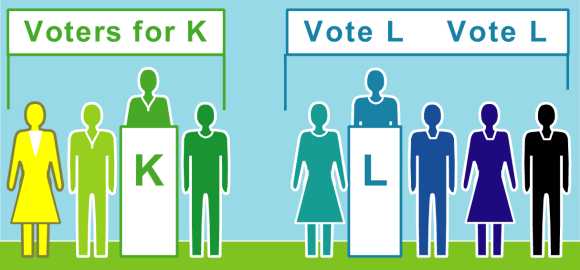
K is nearest four voters. L is nearest five voters.
Condorcet Test Number Three
She has won majorities against each of her rivals. So she is the “Condorcet winner”.
Hint: Is anyone closer to the political center? Yes, No.
Who'd win by Condorcet in the photo above? K, L, M.
Thus a Condorcet Tally picks a central winner.
For example, it can elect a moderator to a council.
But is it likely to elect diverse reps? Yes, No.
And it can set the base of support in Fair Share Voting.
But is it likely to spread spending fairly? Yes, No.
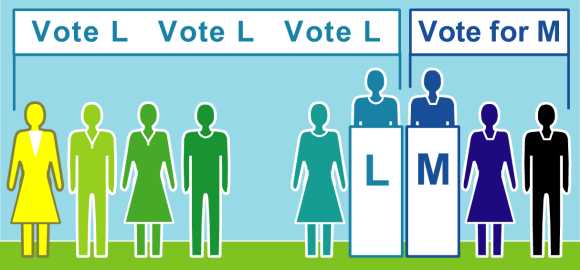
L is nearest six voters; M is nearest three.
The goal of a Condorcet Tally is this:
Majority victories
over every single rival.
The sports analogy is a “round-robin tournament.” A player has one contest against each rival. If she wins all of her tests, then she wins the tournament.
Option J tops option D if most voters rank J above D. Each ballot's rank of J relative to D concerns us.
The numbers of first-rank votes do not.
If another rule picks a different winner our Condorcet winner ranks higher on most ballots. So it wins a one-against-one majority over that other rule's winner.
Condorcet Quickly Picks Balanced Policies
(More merits of the Condorcet or “Pairwise” rule...) |
Policies with Wider Appeal
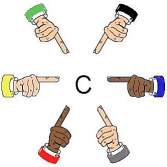
Everyone helps choose our center.
So the Condorcet winner is well balanced and widely popular:2 Most centrist and progressive voters like it more than any conservative policy. At the same time, most centrist and conservative voters like it more than any progressive policy. All sides can join to beat narrowly-centrist policies.
Chairs with Balanced Support
| A Condorcet Tally can elect a central chairperson and a vice chair to hold the powerful swing votes on an Ensemble Council. They compete for support from voters left, right and center. So they have strong incentives to balance a council's process and policies. Proposed policies compete for high ranks from all members, but the chairs often cast the key votes. They can act like the keystone in an arch connecting and bridging. Condorcet tallies will elect about one out of four reps. Proportional Representation will elect the other reps for an Ensemble Council. (IRV elects a strong chief executive to control vetoes within a separation of powers. She is likely to have ties to one of the council’s big parties, which reduces deadlocks.) |
Gerrymanders, rigged voting #1
If the new district a “safe seat” for the bluish party, its core suppoters may prefer a less central nominee. M might lose to someone less moderate in her party's primary — the most challenging election she will have.3 Is the Condorcet winner here the same as on slide 9? Yes, No.
The plurality rules are often easy to manipulate. Borda and score voting are also very susceptible and so make many voters worry about voting tactics. The Condorcet+IRV rule has the lowest risks and worries. So you can simply and safely vote your sincere preferences.2
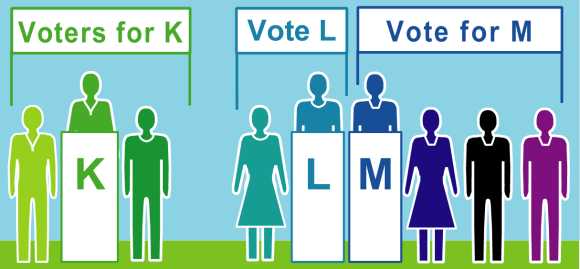
Now K has 3 votes. L has two. And M has four.
Bribes, rigged voting #2
Bribes, big campaign gifts, and jobs for friends can make some reps switch sides on a policy. Condorcet rules resist corruption some, as bribing one rep moves the council's middle, and the winning policy, only a little. This also cuts the payoff to a big campaign sponsor.Voting rules that give fair shares of seats and spending also reduce the payoffs to those who bribe the biggest party. It can no longer seize more than its share of reps or money.
Killer Amendments, rigged voting #3
Like a bribe, a “killer amendment” aims to make some reps change sides, to oppose a bill they had supported. But Pairwise lets reps rank the original bill, no bill, and the “poison-pill” amended bill — so they are able to vote for the bill without the pill.| Bob's Ballot | |
| Rank | Option |
|---|---|
| 2 | Original Bill, the main motion |
| 1 | Bill with Amendment One (a free-rider?) |
| 7 | Bill with Amend. Two (a killer amend.?) |
| 6 | Bill with Amendments One and Two |
| 3 | Postpone for 1 days |
| 4 | Refer the Bill to a Committee |
| 5 | No Change in the status quo |
Stacked Agendas, rigged voting #4
Meetings often make interlocking decisions one at a time. They use a yes-or-no process, with or without explicit rules of order, agendas, and votes. An early proposal may have to beat each one introduced later. An early decision might shut out some later options. So “stacking the agenda” is a way to favor some interests and hurt others.Other meetings discuss rival options all at once; yet many people don't express their backup choices. So similar options split supporters and hurt each other. Then a minority pushing one option can appear to be the strongest group. Even worse, a person with a well-balanced option but few eager supporters might drop it.
Committees sometimes choose parts of a policy. They often allow other voters only a yes-or-no choice. A yes-or-no process may require a committee to report only two options for all members to choose between.
Rigged voting often builds a bad policy and animosity.
To reduce these risks, let the voters rank more options.
Benefits and Costs |
|---|
Steering Analogy
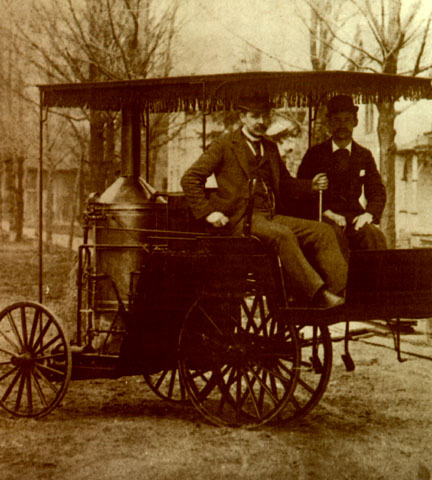 |
Which is more stable and quick? |
|
| |

Does your car have an 1890 steering tiller or a new, power steering wheel? Does your organization have an 1890 voting rule or a new, centered and balanced rule?
Today's drivers need the skill to use power steering — but they don't need the math or logic to engineer it. Same with voters and voting rules.
How to Startup and Test Drive
It's easy for any group to test-drive a new rule in a survey. Or a council can “form a committee of the whole”, to vote, tally and report results to enact by the old yes-or-no rule.Many groups adopt a standard book of parliamentary rules; then they amend it with their own “special rules of order”. So they own a modern vehicle for making their decisions more popular, stable and quick.
Tools Between People
The official rules model the goals and methods for shared decisions. They teach some patterns often followed by our coworkers, friends and neighbors.
Fair rules make cooperation safer, faster and easier. They favor people and groups who tend to cooperate, and may lead others to cooperate more often.
So better rules can help us build better decisions, plus better relationships. Both will please more people. Someone whose income or self-worth comes from war-like politics might not be pleased. But countries with better election rules tend to rank higher in happiness.2 Voting is an exemplary “tool between people.”
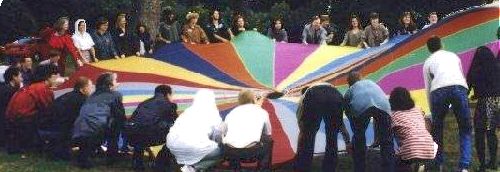
Voting Helps Related Reforms
Public campaign funding in Maine and Arizona lets reps spend less time with rich sponsors and more with voters. One plan would gives each voter $50 of vouchers to donate. Such small, nameless donations or FSV can cut corrupt paybacks.3
One-seat districts let the campaign PACs flood money into the few toss-up districts and thus buy most of those swing seats. But PR has close races in many multi-seat districts, forcing the PACs to spread-out their money into most districts.
Optical-scan ballots, post-election audits and open-source software check fraud by election workers and corporations.
Sabbatical terms make the current rep run against a former rep former rep returning from rest, reflection and field research. The voters get a real choice between two winners. Each has a record of what they did in office. Plurality rule could tend to make the current and former reps both lose by splitting their party. But these ranked choice voting rules do not split parties. A sabbatical might pay each rep only if they work with others from all parties on urban and rural service projects.
Citizens’ assemblies4 and their referendums can get more choices and control by using Condorcet tallies. Laws about reps‘ salaries, fundraising, gifts, ads, election rules, etc. need referendums because on such issues reps have conflicts between their public duty and their private interest. But minority rights to ballots, reps and funds need constitutional protection from the majority of the day.
Voting Reforms Are Cost Effective
The data make it clear: Advocates for education, health care, a clean environment and a clean government should all work for better voting rules. Donors should too.
If we are overwhelmed by urgent needs, we neglect the essentials, the structural roots of these problems. We continue to get bad public policies, due to bad representation, due to bad election laws.
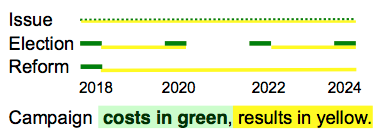
Election campaigns cost a lot all at once. If you win control, you can help all issues for two years.
Reform campaigns cost no more than elections. A win strengthens the council and policies for many years. Your reform work keeps giving to a school, club or town.
Review the Benefits for Voters and Reps
Elections
- Give voters real choices of candidates who can win, by electing fair shares of reps from all big groups.
- This supports a wide range of candidates, debate of issues and turnout of voters.
- Reduce wasted votes to end weak mandates.
Cut the effects of spoilers and gerrymanders.
Reduce the number of districts with safe seats. - Reduce attack ads and anger among voters.
Reduce the payoffs to the big campaign sponsors.
Legislation
Give fair representation to all major groups. So the council enacts laws with real majorities.
 Elect a central chairperson whose swing vote pulls reps from many factions to moderate policies.
Reduce deadlocks and upheavals in budgets or policies. Make shifts in power small, common and smooth.
Cut chances for agenda scams; detach poison-pill and free-rider amendments. Speed-rank all options at once.
Give all members Fair Share Voting for optional budgets. And let the voters easily see each rep's spending.
Philosophy |
|---|
Why Take VotesGroups with little time and many issues or competing interests, often end a discussion by asking for votes not consensus. Their methods of discussion and of voting each affect the quality of their decisions and the group's morale.The secret ballot can protect voters from many types of coercion. The Condorcet policy can please most members best; it is not biased for any group or the current policy. It also does not need to favor the status quo, except bylaws. Fair Share Voting can give fair shares of power. Inclusive yet fast, it doesn't let one member block action. It is co-operative decision making, not individual nor hierarchical, not consensual nor adversarial. Multi-winner rules are less about blocking rivals, more about attracting allies. |
Exit or Power
| One set of policies sometimes cannot suit two groups with opposing values. Moving to a better place is the surest way to get the policies you want. This is often called “voting with your feet”. That is practical when you have the freedom to move and diverse destinations to choose among. Such diversity is more likely when culture and technology give places economic independence through “local self-reliance”. Even when you can't move to a better city or country, you may still avoid willful authoritarians. Build your democratic groups with fair egalitarians. Democracy improves in eras such as The Enlightenment. Many people restrained blind faith, obedience and ideology. They expanded our knowledge of the universe and understanding of life through rational, skeptical, empirical thinking. |
Conclusions
| Many people are excited to learn that voting does not have to mean “winner take all.” The best voting rules strengthen the ballots for voters. This page shows different voting uses |
Actions
| Learn more in this e-book, Accurate Democracy. Then build support in your school, club or town with FairVote, The Center for Voting and Democracy. Steps toward accurate democracy include: This website has sim games and handouts, |
 Organize Voters, with
 | This text is © CC BY-SA 3.0, so edit it as you will and add your own slides for other topics. For example, U.S. voters need concise statements of the principles and benefits in non-partisan redistricting, as practiced in Iowa, and public campaign funding, as practiced in Arizona, Maine, or North Carolina. You may want to skip some topics or change the wording to suit an audience. For legislators you might change “voter” to “rep” or “member” and you would do the opposite for a direct democracy. Thanks to Steve Chessin for writing the original version of the “elevator pitch” for Proportional Representation. He, Terry Bouricius, and Zo Tobi each wrote quick pitches for Instant Runoff Voting which were the basis for the IRV slides above. Overall editors include Tree Bressen, Cheryl Hogue, John Richardson, and Rob Richie. Many others have contributed ideas and writing.
BooksThis primer is part of a free booklet for printers or screens. It has the voting games, colorful graphics from both PoliticalSim™ and the budget voting games, data to compare nations and references. A few hard cover copies are available for college libraries.NavigationThis page showed the need for better voting rules and their merits. The next page, voting games, show the simple steps in each tally and how they meet their goals. After that, you may want to read the one-page introduction to each of the six voting tasks. These tell how a task is like and unlike other uses of voting, what it must do, stories of tragedy and success, the best rule's name, its ballot and its main merits. Accurate Democracy is organized by uses of voting: |

 Accurate Democracy









|
|

Some people want a better Chinese translation. 
And some people want a better Arabic translation.
Please help them.
Dos voluntarios han hecho traducciones al español (Spanish):
DEMOCRACIA CERTERA y DEMOCRACIA CERTERA. ¿Cuál te gusta?