|
Different uses for voting
need different types of voting. |

 |
A Movable-Vote Workshop |
|

|
Get your hands on 4 great voting rules.
See fair-share tallies organize voters. Vote fast on budgets, policies, and projects. |
This workshop shows the simple steps in each tally.
It is much more fun, and memorable, than a lecture. Voters elect varied treats at the end. Eat the winners!
 Instant Runoff Voting elects one candidate. Instant Runoff Voting elects one candidate. Single Transferable Vote elects several. Single Transferable Vote elects several.
 Movable Money Votes buy public goods. Movable Money Votes buy public goods.
 Condorcet Pairwise Voting centers a policy. Condorcet Pairwise Voting centers a policy.
|
|
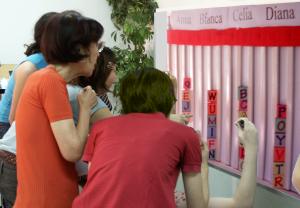
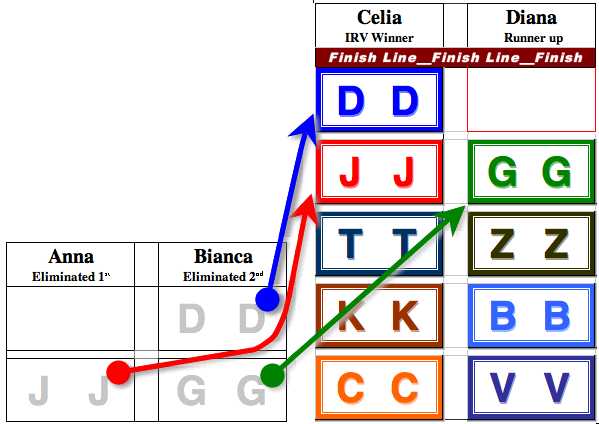
Instant Runoff Voting Elects One CandidateFor a tabletop tally by Instant Runoff Voting (IRV):
The chart below shows four columns on a tally board.
|

|
By organizing voters, Instant Runoff Voting ends:
IRV elects leaders in London, Sidney, San Francisco and more.
Questions on Instant Runoff Voting1. A card that moves is no bigger than any other vote: True, False,Does its voter have more votes or power than any other voter: ? 2. Your backup choice cannot hurt your first choice: True, False, 3. Only one candidate can reach a 50% + 1 vote finish line: True, False, 4. Who could use Instant Runoff Voting ? Answers: Put your mouse pointer on a question, but do not click it.
|
Single Transferable Vote Elects Several RepsFor a three-seat election by Single Transferable Vote (STV):
Single Transferable Vote is used in some Australian and Irish elections, at Harvard, MIT, Oberlin, Princeton, UC Berkeley, UC Davis, and Vassar, at Oxford and Cambridge, in some unions, in the Church of England, and in voting for Hollywood’s Oscars. It gives each group their fair share of voices on a council.
Questions on Single Transferable Vote1. Only three candidates can each win 25% plus one vote: True, False,2. What total percent must the three STV reps win ? 3. Your backup choice cannot hurt your first choice: True, False, 4. What is the threshold for winning one of five seats ? 5. How can groups you know use the Single Transferable Vote ?
|
Movable Money Votes Pick Public GoodsFor Fair Share Voting by Movable Money Votes (MMV):
Fair Shares Set Budgets
(Each funding level of an agency is treated as project. Participatory Budgeting lets neighborhood assemblies spend
FSV is new! Try it! You will build a strong democracy. Questions on Fair Share Voting1. Should we let each member fund private items ?2. Should people who pay more taxes or dues get more power to spend public money ? to set public laws ? 3. Should a rep’s votes be so clear to voters ? 4. Could your second choice hurt your first choice ? 5. How can your groups use Movable Money Votes ?
|
Pairwise Rule Centers a PolicyHere is a hands-on way to show the Marquis de Condorcet'sPairwise rule:
Pairwise is a Wide-Appeal Contest.
If the poles are places for a heater in an icy cold room.
Questions on Pairwise Voting1. Can voters on the fringes affect the Pairwise result ?2. Can the median voter(s) enact any policy alone ? 3. Does Pairwise favor balanced or one-sided policies ? 4. Does it favor narrowly-centrist or broad policies ? 5. Does it eliminate the weakest option and move its ballots ? 6. Should a first-choice vote count more ?
| |||||||||||||||||||||||||||
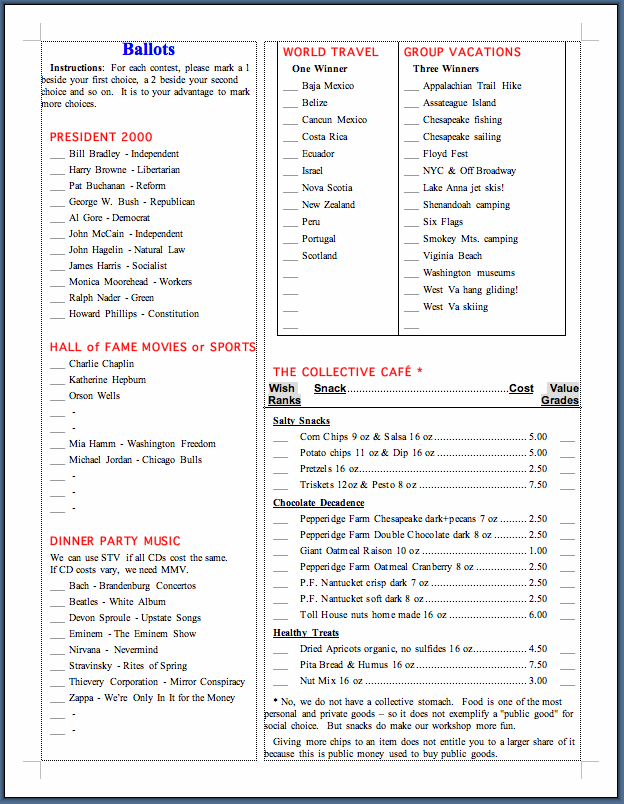
Full-Choice BallotsOnly small groups can use cards for voting. Big groups use paper ballots. They are often tallied by computer, with samples checked by hand. A ballot printed and checked by its voter, and later by a risk-limiting audit, can catch ballot box and tally frauds and errors.Check mark ballots badly oversimplify most issues. Such falsely limited choices let voters see only two factions, “us versus them” or “left versus right”. This tends to polarize debates, harden opinions, increase conflicts. Ranked choice ballots reduce those negative results. They let a voter rank his 1st choice, 2nd choice, 3rd etc. Ranks can reveal a great variety of opinions. Surveys find most voters prefer ranked choice ballots. Fun votes include dinner-party music, favorite videos and snacks, group vacations, pizza toppings, Ben & Jerry’s, sports stars, actors... |
Party Menu | Fill only one “O” on each line. | |||||
| Best | - RANKS - | Worst | ||||
| Deserts | 1st | 2nd | 3rd | 4th | 5th | 6th |
|---|---|---|---|---|---|---|
| Fruits & Nut Platter | ||||||
| 12 Chocolate Brownies | ||||||
| 12 Choc. Chip Cookies | ||||||
| 4 Choc. Fudge FroYos | ||||||
| 4 ‘’ Cheesecake Slices | ||||||
| 6 Choc. Mousse Hearts | ||||||
|
Which wins a plurality? Hint: 5 chocolates vs. 1 nut.
Other pages tell the merits of full-choice ballots and show examples of preference ballots. For anonymity in tabletop voting, you may put your ballot in a box and pull out another voter’s, then move cards for that voter as someone else moves yours.
|
ConclusionsThe best voting rules are fast, easy and fair.They strengthen votes and thus mandates. That means they organize voters and lift the number supporting:  a Chairperson from a plurality to a majority of voters,
a Council from a plurality to over three quarters, a Chairperson from a plurality to a majority of voters,
a Council from a plurality to over three quarters,
 a Budget from a few power blocs to all members,
a Policy from a one-sided to an over-all majority. a Budget from a few power blocs to all members,
a Policy from a one-sided to an over-all majority.
|
Books:This workshop is part of a free book for printers or tablets. The book has the primer, colorful graphics from both PoliticalSim™ and the budget voting game, and data to compare nations. A colorful copy is free for college libraries that will keep it in their catalogue and open-access shelves for six years. The supply is limited, so tell a librarian now!
You may download voting cards formatted in Microsoft Word or Excel, free software, and a template for full-choice ballots. It is rare to lecture on voting rules and find a student who doesn't get it. But many forget the tally logic in a month, simply because they have not used it and don't expect to soon. This workshop creates strong memories by involving a student's senses, physical movement, social interaction, and a favorite treat at the end.
Accurate Democracy is organized by uses of voting:
The next section of the book has another colorful way of making elections visible. Here are the web pages with those graphics for Single Transferable Vote and Movable Money Votes. |



 Accurate Democracy









|
|